Donald's family in uniform, from the Revolution to the Navy in the 1970s, and what the records actually show.
How to read this page. A draft card shows that a man registered, not that he
served. proven means a record or a reliable published source names him.
possible means a record exists but may belong to someone else with the same name. Family stories
and photos are very welcome, so please send them in.
The Vietnam War era: U.S. Navy
Uncle Jim: James C. Norman, Donald's older brother
James C. Norman, "Uncle Jim", was the son of Robert Charles Norman1923–2016 and Joyce Oleana Hartman1927–1986, and Donald's older brother. He was born
in Michigan about 1946. At Plymouth High School (class of 1964) he swam and dove for the school team, as Donald did too.
newspaper On 20 November 1971 the Plymouth Mail reported that Navy Petty Officer Third Class James C.
Norman, son of Mr. and Mrs. Robert C. Norman of Plymouth, was serving aboard the guided-missile destroyer USS Sampson
(DDG-10). That year the ship had won Destroyer Squadron 32's Battle Efficiency "E" award for the second year running. Sampson
was based at Charleston, South Carolina, and her deployments in those years were to the Mediterranean with the Sixth Fleet, not to Vietnam.
So Jim served during the Vietnam War era.
The family believes Jim died in Ann Arbor, Michigan, about two years before Donald. The exact date hasn't been confirmed yet.
Still to find: his enlistment and discharge dates and his rating (his Navy job). His discharge papers (DD-214) or a request to the National
Personnel Records Center would give them. Sources: Plymouth Mail, 20 Nov 1971 (Plymouth District Library archive); Wikipedia,
"USS Sampson (DDG-10)".
The 1960s: U.S. Coast Guard
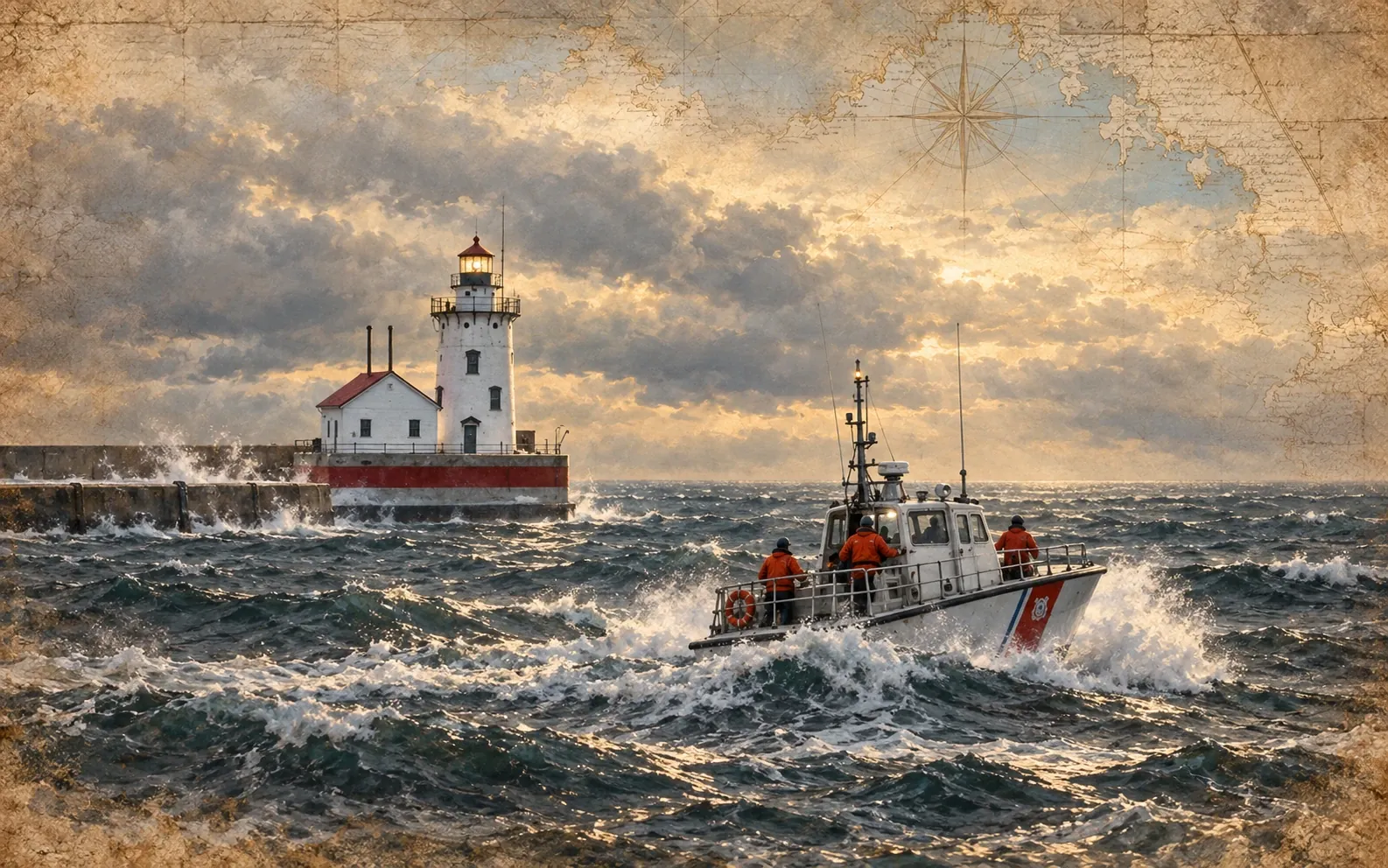
A Coast Guard crew heads out onto Lake Huron. AI-generated illustration inspired by Donald's service at Station Harbor Beach; an artistic impression, not an exact depiction of the station, its lighthouse or its boats.
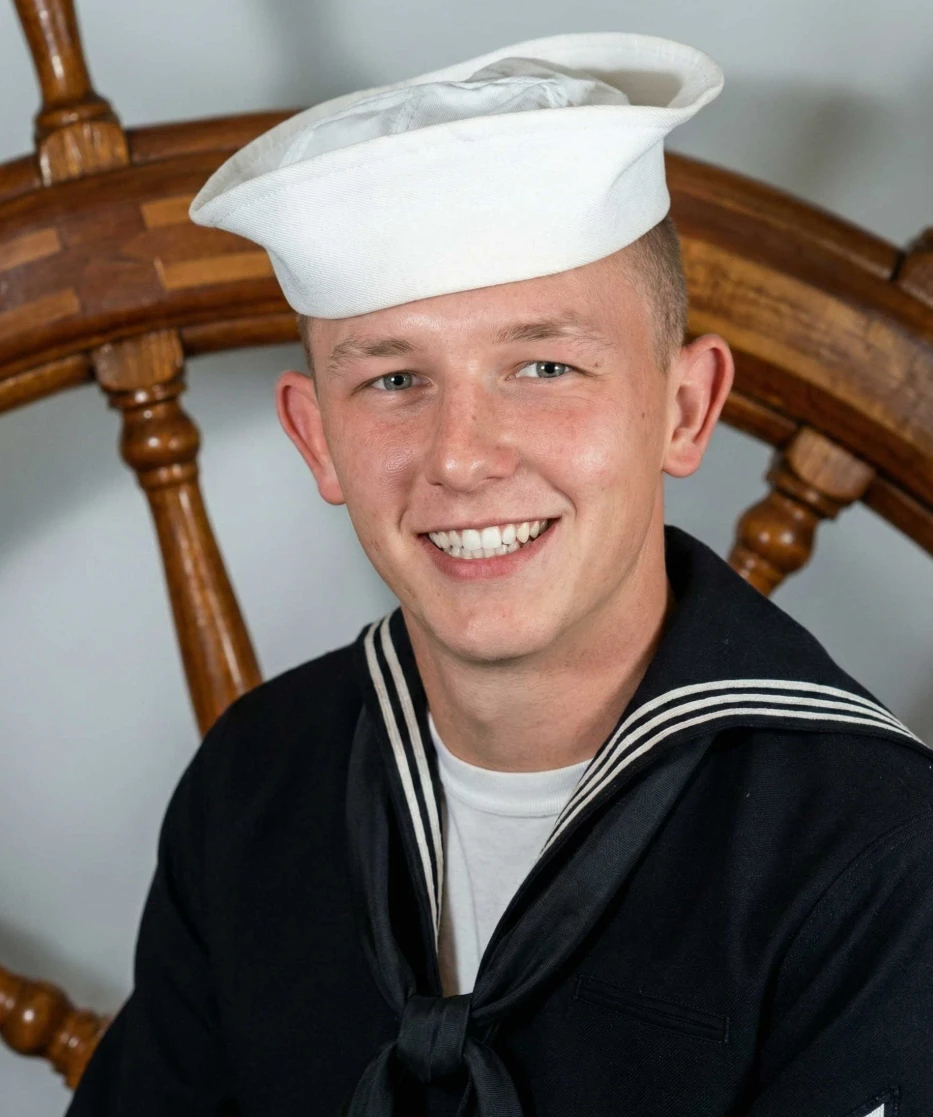
Donald Eugene Norman in dress blues. This copy was restored with AI, which can alter fine details. The original photo is
with the family.
newspaper Donald served in the U.S. Coast Guard at Harbor Beach,
Michigan, on Lake Huron in the Thumb. The family remembers it as a short spell of service; the records below place him at the station from at least February 1966 to October 1967.
He enlisted in August 1965 at the Coast Guard recruiting station in Detroit, straight out of Plymouth High
School, and went to the Coast Guard Recruit Training Center at Cape May, New Jersey, for 12 weeks of basic training
(Plymouth Mail, 4 August 1965, p. 6). Local papers then place him at the Harbor Beach station from early 1966 to late 1967:
February 1966: "Coast Guards give blood". Donald was one of eight men from the station, led by their chief
boatswain's mate, who gave blood at the Harbor Beach Community Hospital drawing on 8 February 1966. The drawing collected 47
pints (Harbor Beach Times, 17 February 1966, p. 2).
March 1966: a farewell party at the station for a man retiring after 20 years in the Coast Guard. The report
lists the station staff, including Donald Norman, and notes that the station "remained open all winter" (Port Huron
Times Herald, 7 March 1966, p. 7, "Coast Guardsmen Bid Farewell…").
The rescue on Lake Huron, October 1967
On the morning of Tuesday, 24 October 1967, at about 10:43, a sailor aboard the lake steamer Reserve was stricken with
chest pains. The ship was upbound about 18 miles north of Harbor Beach. The Coast Guard was notified, and a three-man boat crew went
out. Among them was Seaman (SN) Donald Norman, who, in the paper's words, "answered the call". A helicopter from
Selfridge Field arrived at noon and took the sick man off the ship for medical care.
Source: "Sailor Removed From Steamer", Harbor Beach Times, Thursday 26 October 1967, p. 1
(found on Newspapers.com). The other crewmen and the sailor are named in the article but not here, as they may still be living.
Coast Guard Station Harbor Beach traced its roots to a lifesaving station of the 1880s. It guarded one of the largest man-made
freshwater harbors in the world, and it operated until 1987.
Station history: Thumbwind, "The Pier Based Coast Guard Station Harbor Beach". Still to find: his exact dates of
service. A request for his service record to the National Personnel Records Center would give them.
World War II
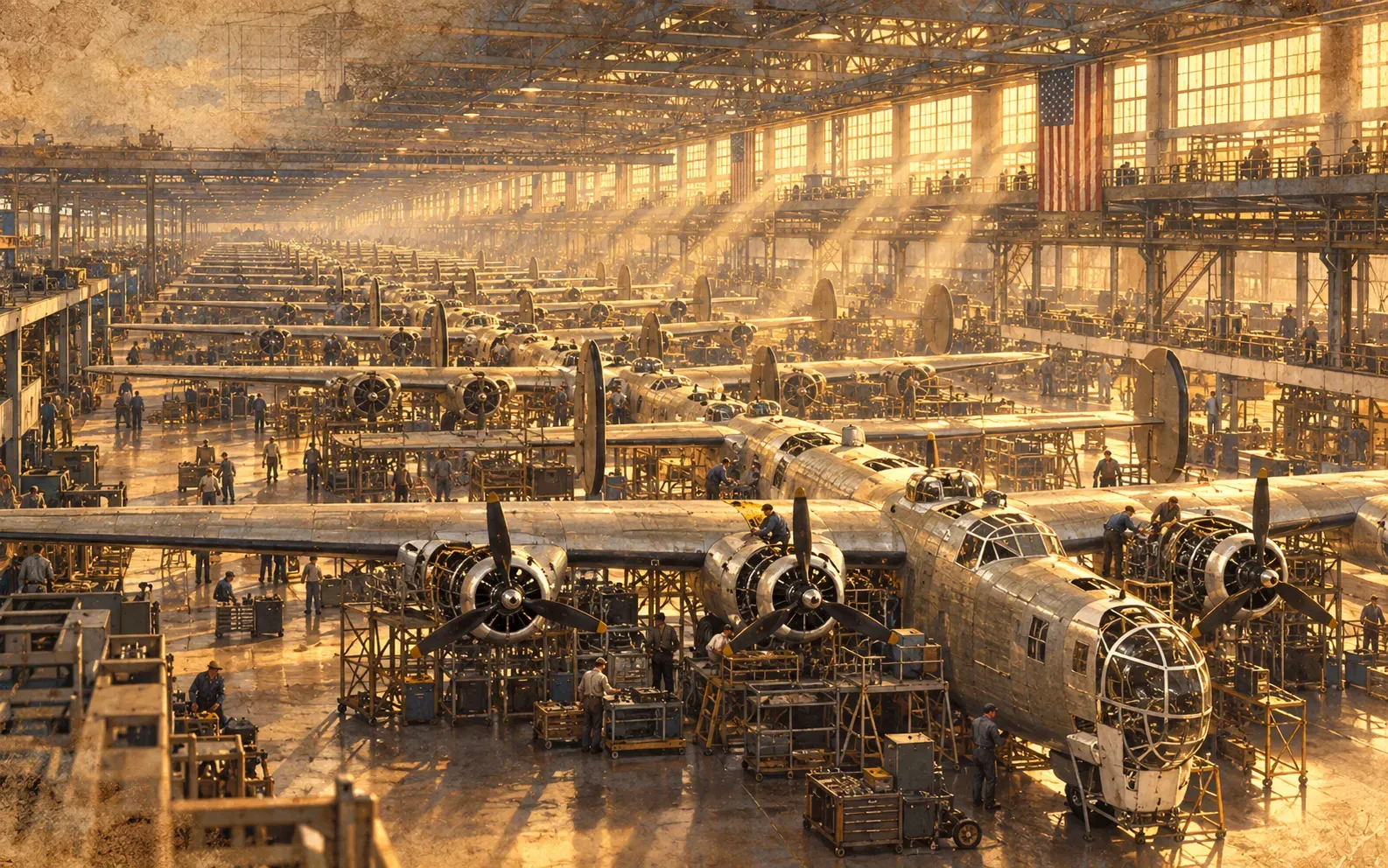
B-24 Liberators on the assembly line at a wartime bomber plant, about 1943. AI-generated historical illustration inspired by Ford's Willow Run plant, where Robert Charles Norman worked; an artistic impression, not a photograph.
records Donald's father, Robert Charles Norman, was born on 8 March 1923 at Newburg, a village in
Livonia Township, Michigan. When he registered for the WWII draft he was living in Plymouth, Michigan, and working at the
Willow Run Bomber Plant near Ypsilanti. Ford built that plant in 1941 to mass-produce the B-24 Liberator
heavy bomber. It was one of the largest factories in the world, and at its peak in 1944 it turned out about 650 B-24s a month.
At Plymouth High School, "Bob Norman" was a star athlete from 1937 to 1941. He played football as quarterback and receiver,
played basketball (he was team captain in 1940), and was on the tennis team. His obituary says he went to Michigan State on a
tennis scholarship, and he kept playing tennis into his late eighties.
He enlisted in the U.S. Army on 15 January 1943 and was discharged on 13 March 1946. In
March 1946 the Plymouth Mail reported that "after serving more than three years in service, T/5 Robert C.
Norman" had arrived home at his parents'. T/5 (Technician Fifth Grade) was an enlisted Army technician's rank.
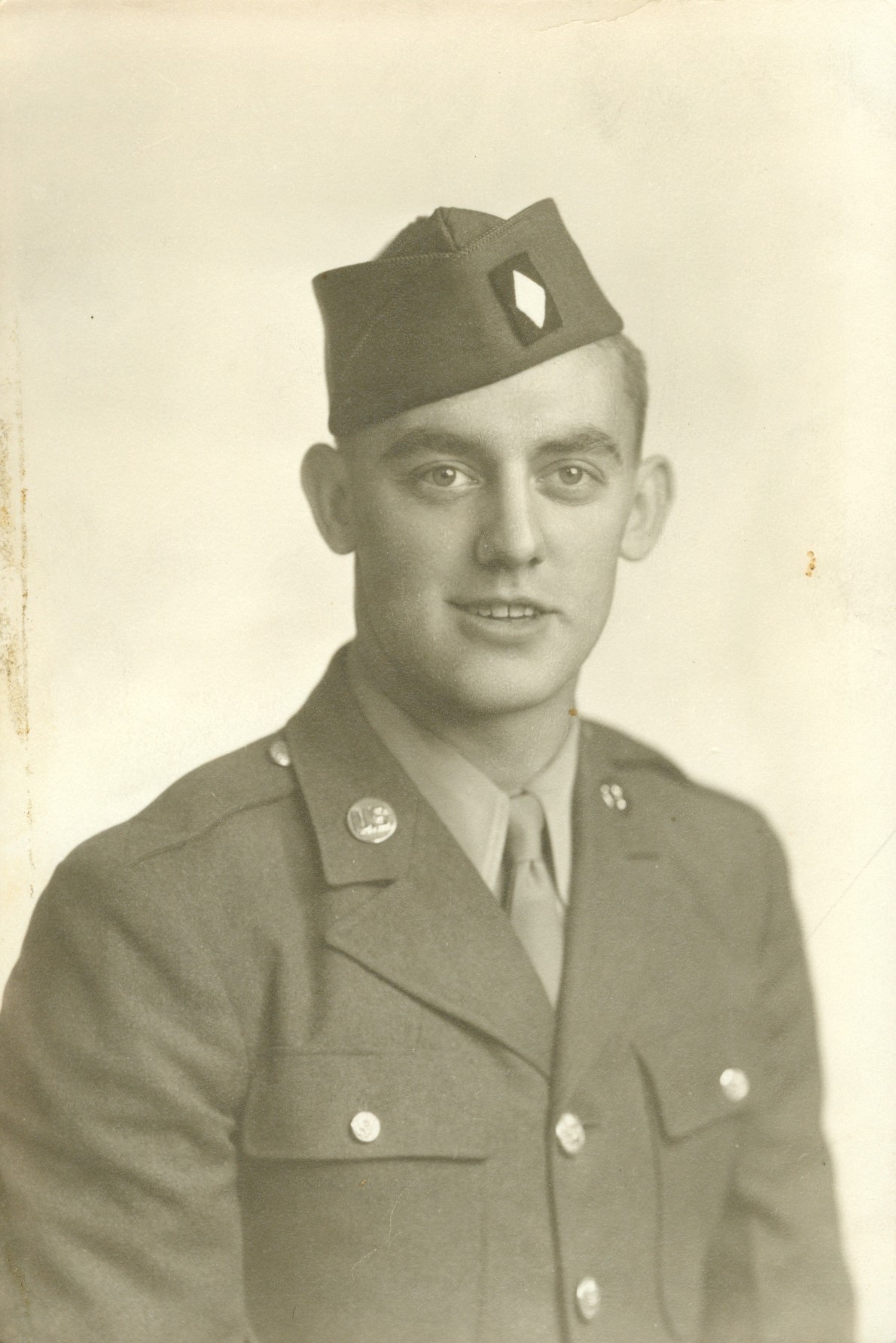
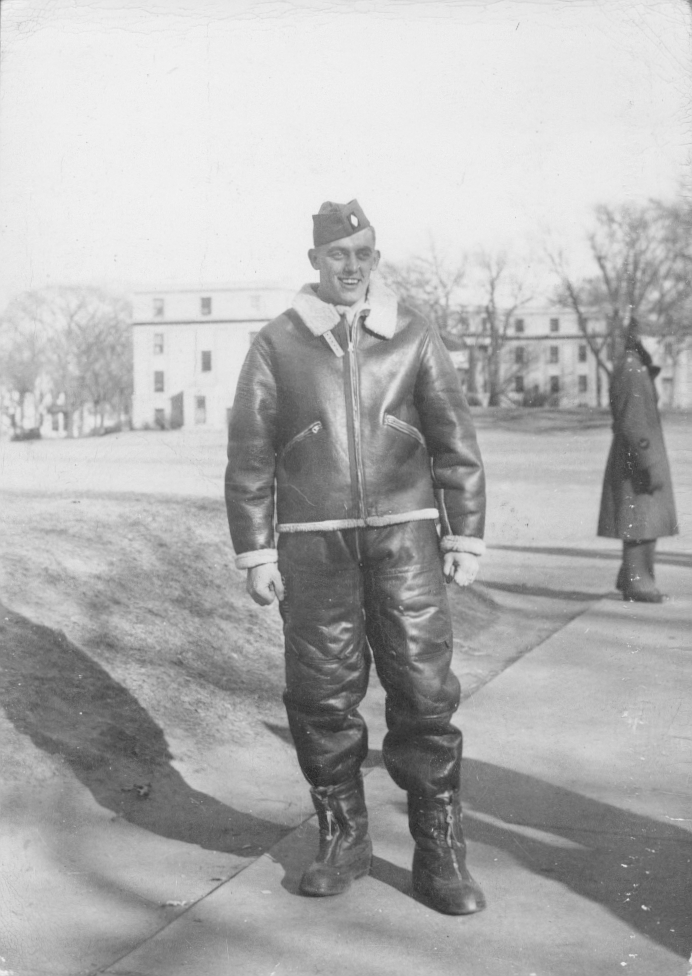
Robert Charles Norman's Army portrait, WWII. The cloth patch on his garrison cap hasn't been identified yet.
Can you tell what it is? Family photo.In a sheepskin flight suit, wearing the same cap patch. Family photo.
family story He trained as a pilot and was close to earning his wings when a football knee
injury he'd been hiding gave out. That kept him out of combat flying. A family photo shows him in full bomber-crew cold-weather
flight gear at what looks like a training base, which fits the story. Aviation cadets who earned their wings were normally made officers, so his T/5 rank in 1946 fits a man who
left flight training. Only his service file can show what actually happened.
Sources: his WWII draft registration card (National Archives at St. Louis) and U.S. veterans' records of his
enlistment and discharge dates (U.S. Department of Veterans Affairs BIRLS death file), both found in Robert's Ancestry research; Plymouth Mail 18 Jun 1943 p. 13 and 22 Mar 1946 p. 7, and 1937–41 sports pages (Plymouth District Library archive); obituary (Kalkaska Funeral Home, 2016, on Find a Grave). Willow Run: Detroit Historical Society and
The Henry Ford.
Still missing: his Army serial number, unit and training bases. His personnel file may
have been lost in the 1973 fire at the National Personnel Records Center in St. Louis, which destroyed about 80% of the files
for Army soldiers discharged between 1912 and 1960. Next steps: Fold3; FamilySearch; WWII hospital admission records (which
might show the knee injury); and a records request to the National Archives. Even a burned file can often be partly rebuilt
from other records.
newspaper Robert Charles's brother William also served. On 1 March 1946 the Plymouth Mail reported that
William Norman, BM 1/c (boatswain's mate first class), son of Mr. and Mrs. James Norman, had just arrived home. A boatswain's mate
looked after a ship's deck, rigging and small boats, and first class was a senior petty officer's rate.
Source: Plymouth Mail, 1 Mar 1946 (Plymouth District Library archive). Still to find: his ships and dates of service.
Two older men in the family also registered in the WWII draft: James Norman1891–1974, then 51 and living in Plymouth,
Michigan, and Charles Edward Hartman1899–1975 in North Carolina. No record has been found that either man served.
World War I
James Norman1891–1974, a young English immigrant in Detroit, registered for the WWI draft in Wayne County, Michigan, in
1917–18, the same years he petitioned for American citizenship (6 May 1918). No record of service has been found for him, or for
Charles Edward Hartman1899–1975, who turned 19 in September 1918.
Next steps: WWI service abstracts (Michigan and New York) and naturalisation papers, which sometimes
mention military service.
The Civil War years
No direct ancestor's Civil War service has been confirmed yet, but the family didn't escape the war.
Elijah Gaither1816–1863 of Iredell County, North Carolina, died on 3 April 1863, in the middle of the war, aged 46. No
Confederate record and no cause of death has been found. open question
possible Elijah's younger brother Wiley Gaither1829–1864. The North Carolina Confederate
roster lists a Wiley Gaither (spelled "Giather") of Davie County, born about 1827, who enlisted on 13 August 1862
at age 35 as a private in Company G, 5th North Carolina Infantry. He was recorded as absent without leave in
May 1863 and returned that September. He was wounded and captured at Spotsylvania Court House, Virginia, on 9 May 1864,
and died a prisoner of war. The county, rough age and year of death (1864 in our tree) fit, though the tree has him born in 1829 in Iredell County, so the match isn't
proven yet. Several other Davie and Iredell County Gaithers also served, probably cousins.
Source: North Carolina Troops 1861–65: A Roster, via Ancestry, "U.S., Civil War Soldier
Records and Profiles". Next step: his compiled Confederate service record and the 1850/1860 censuses.
The tree attaches a Pennsylvania Civil War muster roll to John Powers1815–1903. But his family was still in County
Wicklow, Ireland, in the 1860s and 1870s, so that record almost certainly belongs to a different John Powers.
The German families (Schrader in Sanilac County, Michigan; Hartman in Rockland County, New York) and the Crater
family of Iredell County, North Carolina, were all in America during the war. Their service records haven't been searched yet.
War of 1812
The tree calls Benjamin Gaither's son Edward B. Gaither (1787–1856, who died in Cannon County, Tennessee) "Captain".
The only Captain Edward B. Gaither found in the War of 1812 is a different man, a Kentucky doctor from the Montgomery County,
Maryland Gaithers. Until a record turns up, the title is left off.
Thomas Comer of Halifax County, Virginia, is recognised by the Daughters of the American Revolution as a
Patriot (DAR ancestor no. A024709), for furnishing supplies to the Revolutionary cause. He was
in his fifties when the war began. Donald's line comes down through his son Archibald "Archer" Comer.
The family tree also says he served in the 7th Virginia Regiment. A Thomas Comer does appear on that
regiment's rolls, but DAR credits our Thomas only with supplies, so the soldier was probably a younger man of the same name.
Source: DAR record as quoted on WikiTree (Comer-272). soldier claim unproven
Benjamin Gaither of Anne Arundel County, Maryland, Donald's 4th great-grandfather. The Society of John Gaither
Descendants and WikiTree say that a Benjamin Gaither served as 1st Lieutenant in the 29th Battalion of Maryland
Militia in 1776 and took Maryland's Oath of Fidelity in 1778. Our tree cites Revolutionary War
records for him too. But there were several Benjamin Gaithers in Maryland, and sources disagree about where ours died,
Maryland or Rowan County, North Carolina. So this isn't proven for our Benjamin yet.
Next steps: Henry C. Peden, Revolutionary Patriots of Anne Arundel County; the DAR Genealogical
Research System; and Rowan County, North Carolina wills and land grants (1778 onwards).
No loyalists have been found in the direct line.
Help fill this page
Do you have a uniform photo, a discharge paper, medals, letters home or a family story? Those are exactly what this page needs.
Unit names and dates, even rough ones, make the official records much easier to find.